<?xml version="1.0" encoding="utf-8"?><feed xmlns="http://www.w3.org/2005/Atom" ><generator uri="https://jekyllrb.com/" version="3.10.0">Jekyll</generator><link href="https://olexandr-konovalov.github.io/feed.xml" rel="self" type="application/atom+xml" /><link href="https://olexandr-konovalov.github.io/" rel="alternate" type="text/html" /><updated>2026-02-24T16:21:42+00:00</updated><id>https://olexandr-konovalov.github.io/feed.xml</id><title type="html">Dr. Olexandr Konovalov</title><subtitle>Lecturer at the School of Computer Science</subtitle><author><name>Dr. Olexandr Konovalov</name></author><entry><title type="html">Resilient Carpentries: running a workshop in times of the war</title><link href="https://olexandr-konovalov.github.io/posts/2026/02/24/resilient-carpentries/" rel="alternate" type="text/html" title="Resilient Carpentries: running a workshop in times of the war" /><published>2026-02-24T00:00:00+00:00</published><updated>2026-02-24T00:00:00+00:00</updated><id>https://olexandr-konovalov.github.io/posts/2026/02/24/resilient-carpentries</id><content type="html" xml:base="https://olexandr-konovalov.github.io/posts/2026/02/24/resilient-carpentries/"><![CDATA[<p>On 20-21 January 2026 the <a href="https://ukrainian-carpentries.github.io/">Ukrainian Carpentries Community</a> 
run the first ever
<a href="https://ukrainian-carpentries.github.io/2026-01-20-dnipro-online/">Carpentries workshop in Ukraine</a>,
making Ukraine the 72nd country in the world hosting The Carpentries workshops.</p>

<p>This workshop was a part of the
<a href="https://sau.nmu.org.ua/ua/school_analysis.intelligence/2026/winschool26.php">Winter School in System Analysis and Artificial Intelligence</a>,
organised by the <a href="https://sau.nmu.org.ua/ua/">Department of System Analysis and Control</a>
of <a href="https://nmu.org.ua/">Dnipro Polytechnic</a>.</p>

<p>Dnipro Polytechnic is located in the centre of the city of Dnipro. Dnipro is the fourth largest city in Ukraine, situated just 70 km north from my home city Zaporizhzhia. 
I visited Dnipro many times, travelling by car, bus, train, plane and even by a hydrofoil boat.
But since the beginning of russia’s full scale invasion in Ukraine - exactly 4 years ago today - both Dnipro
and Zaporizhzhia turned into frontline cities.
The air raid alerts and electricity blackouts became regular events. 
Still, in such conditions under relentless russian attacks, 
Ukrainian academics and students gather for these winter schools, and not for the first time - this is
already the 3rd of the series, with the first one held in January 2024
(see the list of all schools <a href="https://sau.nmu.org.ua/ua/school_analysis.intelligence/schoolregulation.php">here</a>).
I admire their resilience, and it was an honour for me to get involved.</p>

<p>This wasn’t our first collaboration: in January 2024, 
the Ukrainian Carpentries Community already run a pilot <a href="https://ukrainian-carpentries.github.io/trainings">Git training</a>
for the initial school of the series. That was the first Git training we conducted using 
the <a href="https://ukrainian-carpentries.github.io/git-novice/">Ukrainian version of the Version Control with Git lesson</a>.
Now in 2026 the Winter School organisers were inviting us to do the Git training again, and we met at one 
of <a href="https://hackmd.io/drNoAPc5QpqH4nWm71YJkg?view">our monthly calls</a> in November to discuss the possibility of organising
a full Carpentries workshop, teaching not just Git, but also UNIX shell and some programming language. To support this,
we already translated all episodes of UNIX shell lesson, large part of the Python lesson, and a workshop template, all listed on <a href="https://ukrainian-carpentries.github.io/">our webpage</a>.</p>

<p>However, we have discovered that the majority of participants are expected to be undergraduate students of computer science
or electrical engineering degrees who are already well familiar with Python. 
Therefore, teaching Python does not seem to be a wise approach. 
Luckily, a few months before a group of translators in the National University of Ostroh Academy (twinning
partner of the University of St Andrews) started to translate the <a href="https://ukrainian-carpentries.github.io/r-socialsci/">R for Social Scientists</a> lesson. 
Dr Yurii Kleban, who coordinated the work of two Ostroh Academy students
(Daria Stehnii and Bohdana Strelyuk), is an R expert who has previously been helping at our training and 
witnessed The Carpentries pedagogical approach in practice. He enthusiastically volunteered to prepare and teach R at our workshop at the Winter School, and the translators of the R lesson
 volunteered to intensify their translation and reviewing efforts. 
 They translated 100% of the text, and thanks to them, by the time of the workshop we were able to render the translated lesson website with nearly 60% of the translations reviewed, approved, and visible online.</p>

<p>Planning to run a workshop under air raids and blackouts required us to think of many things not covered by <a href="https://docs.carpentries.org/">The Carpentries Handbook</a>.</p>

<p>First, we have decided to start the Carpentries part of the Winter School as early as possible in the week, and suggested that instructors and helpers should reserve, if possible, some additional time after the two initial days of the workshop, just in case we need to reschedule some sessions.</p>

<p>All sessions were recorded in the Microsoft Teams channel of the Winter School, so that participants may catch up later if they were forced to skip some sessions because of an air raid alert or problems with Internet connection. Some of the recordings were later published <a href="https://www.youtube.com/@depSAaC_NTUDP/videos">here on YouTube</a>.</p>

<p>The School organisers wanted to provide certificates of attendance to participants. Of course, in these conditions this cannot be based solely on their presence in online sessions, and hence the learners were asked to provide some evidence of following the content of the workshop. For example, for Day 1 the evidence was the URL of the public repository created following the Git lesson. Thus, learners missing the session could have followed the recording on their own and submit the result.</p>

<p>Some participants of the live sessions were unable to join us from their computers during electricity blackouts, and were joining the call from mobile devices. In particular, by the time of the collaborative exercise at the end of the Git lesson, only about 10 learners were able to stay on their computers. Therefore, we have decided to organise breakout rooms in a way that each room has two learners who use computers, and everyone else is watching what are they doing from a mobile device, and can try to simulate and merge conflicts in their own time later.</p>

<p>We also had to discuss what would happen if Yurii loses power during his teaching of R on Day 2. Yurii said that in case of a blackout he would be able to stay connected and teach for another hour using his reserve power supply. This would give us some time to decide what to do next - either he could relocate during the break, or I can jump in and teach from where he stopped (because we are using the standard Carpentries lesson which provides interoperability between instructors). Yurii also had his own slides prepared for teaching, so if anything happened, perhaps he would also be able to demonstrate them from a mobile device. Luckily, his teaching went without disruptions.</p>

<p>There was also an additional question about installation instructions for the UNIX shell and Git for Windows.
Our <a href="https://ukrainian-carpentries.github.io/workshop-template/">translated workshop template</a>
still suggests to use Git Bash and not the Windows Subsystem for Linux v2 (WSL2)
which is the current default option for the
<a href="https://carpentries.github.io/workshop-template/">English workshop template</a>. 
We simply had not managed yet to catch up with all template updates (while we use <a href="https://crowdin.com/">crowdin.com</a> to translate the lessons, the template was translated straightforwardly in a fork of the <a href="https://github.com/carpentries/workshop-template/">workshop template repository</a>). 
However, in my opinion going with Git Bash was easier, and we would not have capacity to provide support for WSL2 installation remotely. See also this <a href="https://github.com/carpentries/workshop-template/issues/887">GitHub issue</a> for the discussion started by Sarah Stevens.</p>

<p>As a result, we had 46 registered participants, representing 9 universities from 6 cities. 
Day 1 was UNIX shell and Git; Day 2 was Programming in R. Overall, the workshop went well. 
I would like to thank everyone: the learners for their resilience and perseverance; 
our helpers (Roman Ilyushin, Volodymyr Kharchenko, Iryna Raievska, Maryna Raievska,
Veronika Shevchenko, Bohdana Strelyuk), the majority of which also took part
in the translation work and were delighted to see the outcomes of their efforts in practice; 
local organisers (Olha Stanina and Svitlana Us); 
and my fellow instructor Yurii Kleban. Each of you helped to make it happen!</p>]]></content><author><name>Dr. Olexandr Konovalov</name></author><summary type="html"><![CDATA[On 20-21 January 2026 the Ukrainian Carpentries Community run the first ever Carpentries workshop in Ukraine, making Ukraine the 72nd country in the world hosting The Carpentries workshops.]]></summary></entry><entry><title type="html">Git training in Ukrainian at Research Software Camp: Careers and Skills in Research Software</title><link href="https://olexandr-konovalov.github.io/posts/2025/11/10/Git-training-Ukraine/" rel="alternate" type="text/html" title="Git training in Ukrainian at Research Software Camp: Careers and Skills in Research Software" /><published>2025-11-10T00:00:00+00:00</published><updated>2025-11-10T00:00:00+00:00</updated><id>https://olexandr-konovalov.github.io/posts/2025/11/10/Git-training-Ukraine</id><content type="html" xml:base="https://olexandr-konovalov.github.io/posts/2025/11/10/Git-training-Ukraine/"><![CDATA[<p>The <a href="https://www.software.ac.uk/Events/research-software-camp-careers-and-skills-research-software">“Research Software Camp: Careers and Skills in Research Software”</a>
organised by the <a href="https://software.ac.uk/">Software Sustainability Institute</a>
will include a workshop on version control in Git, which will be taught
in Ukrainian on November 17th. <a href="https://www.eventbrite.co.uk/e/git-tickets-1733696796789"><strong>Click here to register</strong></a>!</p>

<p><strong>Update 1:</strong> Thank you to the Department of Computer Science and Information
Technologies of О. М. Beketov National University of Urban Economy in Kharkiv
for the nice feedback!
[<a href="https://knit.kname.edu.ua/8-novosty/302-vikladachi-kafedri-komp-yuternikh-nauk-ta-informatsijnikh-tekhnologij-vzyali-uchast-u-seminari-kontrol-versij-za-dopomogoyu-git-za-programoyu-research-software-camp-careers-and-skills-in-research-software"><em>Українською</em></a>]
[<a href="https://knit.kname.edu.ua/en/8-novosty/303-teachers-of-the-department-of-computer-science-and-information-technology-participated-in-the-seminar-version-control-using-git-as-part-of-the-program-research-software-camp-careers-and-skills-in-research-software"><em>English</em></a>].</p>

<p><strong>Update 2:</strong> the recording of the workshop is now available <a href="https://www.youtube.com/watch?v=H6_hg-PNlSs">here</a>.</p>]]></content><author><name>Dr. Olexandr Konovalov</name></author><summary type="html"><![CDATA[The “Research Software Camp: Careers and Skills in Research Software” organised by the Software Sustainability Institute will include a workshop on version control in Git, which will be taught in Ukrainian on November 17th. Click here to register!]]></summary></entry><entry><title type="html">Ukrainian Carpentries Community website</title><link href="https://olexandr-konovalov.github.io/posts/2025/04/26/ukrainian-carpentry/" rel="alternate" type="text/html" title="Ukrainian Carpentries Community website" /><published>2025-04-26T00:00:00+01:00</published><updated>2025-04-26T00:00:00+01:00</updated><id>https://olexandr-konovalov.github.io/posts/2025/04/26/ukrainian-carpentry</id><content type="html" xml:base="https://olexandr-konovalov.github.io/posts/2025/04/26/ukrainian-carpentry/"><![CDATA[<p>Our project for translating Software Carpentry lessons into Ukrainian
language has evolved further. We are now a community within The Carpentries,
and we have established a webpage
at <a href="https://ukrainian-carpentries.github.io/">https://ukrainian-carpentries.github.io/</a>.</p>]]></content><author><name>Dr. Olexandr Konovalov</name></author><summary type="html"><![CDATA[Our project for translating Software Carpentry lessons into Ukrainian language has evolved further. We are now a community within The Carpentries, and we have established a webpage at https://ukrainian-carpentries.github.io/.]]></summary></entry><entry><title type="html">Software Carpentry for Ukraine: status update</title><link href="https://olexandr-konovalov.github.io/posts/2024/04/18/ukrainian-carpentry/" rel="alternate" type="text/html" title="Software Carpentry for Ukraine: status update" /><published>2024-04-18T00:00:00+01:00</published><updated>2024-04-18T00:00:00+01:00</updated><id>https://olexandr-konovalov.github.io/posts/2024/04/18/ukrainian-carpentry</id><content type="html" xml:base="https://olexandr-konovalov.github.io/posts/2024/04/18/ukrainian-carpentry/"><![CDATA[<p>This is an overview of the current state of the project of translating
Software Carpentry lessons into Ukrainian language. It accompanies the 
<a href="https://zenodo.org/records/10995105">slide of my lightning talk</a> at the
<a href="https://www.software.ac.uk/workshop/collaborations-workshop-2024-cw24">Collaborations Workshop 2024</a>.
It is also <a href="https://carpentries.org/blog/2024/05/software-carpentries-translation-efforts-in-ukrainian/">republished on The Carpentries website</a>,
but without the updates at the end of this post.</p>

<p>This project was initiated by me in summer 2022, and after getting some initial
practice with the translation toolchain in a small team,
in 2023 we have invited St Andrews students to join us under the 
<a href="https://www.st-andrews.ac.uk/students/academic/internships/staris/">StARIS</a>
and <a href="https://olexandr-konovalov.github.io/posts/2023/04/24/carpentries-step-up/">STEP</a>
programmes, and also <a href="https://olexandr-konovalov.github.io/posts/2023/03/28/carpentries-translation/">invited external contributors</a>.
By now the project involves 16 members from 6 locations, interacting via
a Slack workspace and regular monthly video calls.</p>

<p>We very much appreciated the ability to access the existing Carpentries translation
infrastructure, which used the <a href="https://www.transifex.com/">Transifex</a>
platform for collaborative translation (personal thanks to David Pérez-Suárez
for all the help with setup and rendering lessons). A pilot training in
version control with Git in Ukrainian took place at
<a href="https://www.eventbrite.co.uk/e/git-version-control-in-git-tickets-650799186887">Research Software Camp: FAIR Software</a> in June 2023,
with <a href="https://www.youtube.com/watch?v=RAaROljwy38">its recording available on YouTube</a>.
However, while the training was delivered in Ukrainian, at that time
we still did not have a proper online version of the Git lesson in Ukrainian.</p>

<p>Continuing translation, by the start of 2024 we achieved further progress
with a few more lessons, most notably with the following four:</p>
<ul>
  <li><a href="https://swcarpentry.github.io/shell-novice/">The Unix Shell</a></li>
  <li><a href="https://swcarpentry.github.io/python-novice-gapminder/">Plotting and Programming in Python</a></li>
  <li><a href="https://datacarpentry.org/r-intro-geospatial/">Introduction to R for Geospatial Data</a></li>
  <li><a href="https://carpentries-incubator.github.io/gap-lesson/">Programming with GAP</a></li>
</ul>

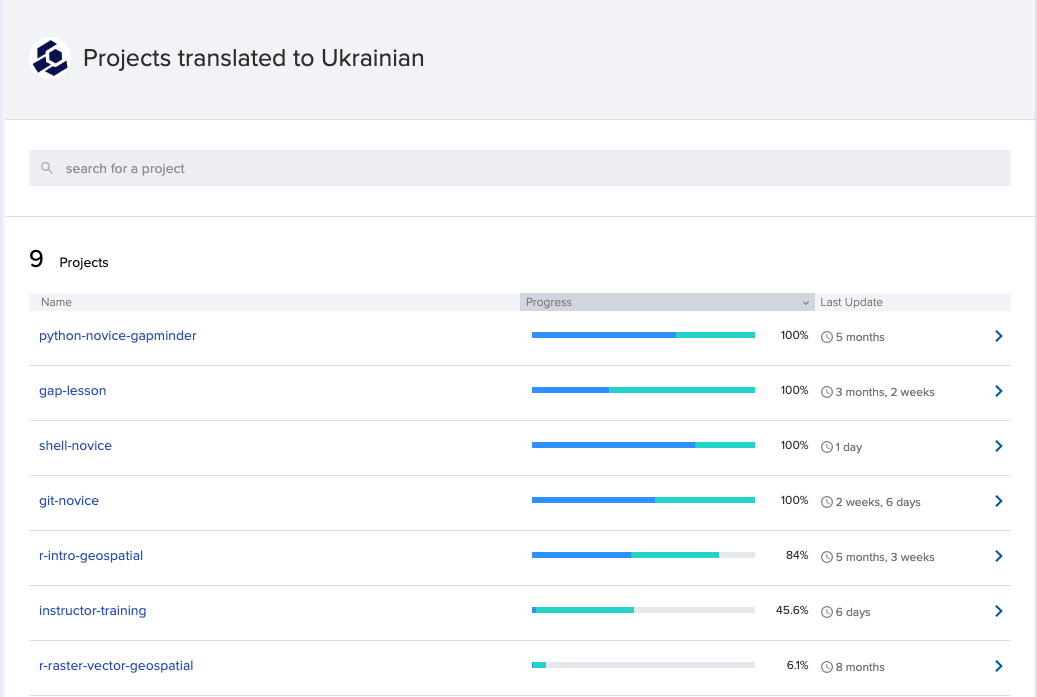
<p>The image below shows the level of completion of the initial translation (green)
and its review (blue) for each lesson as it was in January 2024, just before we
started migration to another collaborative platform called <a href="https://crowdin.com/">Crowdin</a>.</p>

<p><img src="https://olexandr-konovalov.github.io/images/Transifex-2024-01-31.png" alt="Transifex translation completion - January 2024" /></p>

<p>The <a href="https://crowdin.com/">Crowdin</a> platform offers better opportunities
for us, both in terms of its functionality and of the translation workflow,
with semi-automated rendering of the online version of the translated lesson
requiring only to press a few buttons in Crowdin and GitHub. In addition,
it will be already adapted to the most recent template of the Carpentries
lessons, called <a href="https://carpentries.github.io/workbench/">Workbench</a>. 
As soon as all the needed setup will be implemented in the Carpentries
Crowdin organisation, we expect to provide online Ukrainian versions of
all translated lessons very soon.</p>

<p>Right now we are ready to organise stand-alone trainings
in using version control with Git, and have already conducted a few ones.
The first online one in January 2024 was at the Winter School in System Analysis
and AI at Zaporizhzhia &amp; Dnipro Polytechnics. For the first time, it
used the online lesson “Контроль версій за допомогою Git” (Version control
with Git), available at
<a href="https://ukrainian-carpentries.github.io/git-novice/">https://ukrainian-carpentries.github.io/git-novice/</a>,
and already using the new Workbench template
(you can compare it with the <a href="https://swcarpentry.github.io/git-novice/">English version here</a>).</p>

<p>This became possible thanks to the Bioconductor team for letting us temporarily use their
Crowdin account, and personally to Joel Nitta for exporting translations
from Transifex to Crowdin on a very short timescale. After the export, we
only had to manually migrate some text fragments, not picked up by the automated
procedure, and then approve all the remaining translations.</p>

<p>In March, another training was organised for the Ostroh Academy
(University of St Andrews’ partner under the UK-Ukraine Twinning Initiative).
That was a hybrid event, with helpers present in the room
to respond to pink sticky notes when learners needed help (for the news item and photos, see
<a href="https://www.oa.edu.ua/ua/info/news/2024/06-03-01">“В Острозькій академії відбувся весняний семінар комп’ютерної школи”</a>).</p>

<p>Furthermore, Zaporizhzhia Polytechnic is now using the Git lesson as a
foundation for one of the courses for the PhD students of the Department
of System Analysis and Computational Mathematics.</p>

<p>The next goal is having available online a full set of lessons for a standard
Python, R or GAP based Software Carpentry workshop. Once at least one of these
three lessons on programming will be completed, we would be ready to organise a full scale
Software Carpentry workshop (i.e. involving programming, UNIX shell and Git lessons)
for Ukrainian-speaking audience, and start to build a community of the Carpentries
instructors in Ukraine (translation of the instructor training curriculum is already
in progress). Please contact me if you’re interested to learn more and take part
in this initiative!</p>

<p><strong>Update 1:</strong> [2024-06-16] The Carpentries Workshop Template has been
translated as well: <a href="https://ukrainian-carpentries.github.io/workshop-template/">https://ukrainian-carpentries.github.io/workshop-template/</a>.</p>

<p><strong>Update 2:</strong> [2024-06-25] I have a short talk about this, with some most
recent updates, at the SSI Fellows Community Call on 11th June 2024. Its
recording is available <a href="https://www.youtube.com/watch?v=kyp8B3VNapM">here</a>.</p>

<p><strong>Update 3:</strong> [2024-11-18] In summer 2024 we run a STEP project
“Adding Ukrainian translations to Glosario - an open source glossary of terms used in computing and data science”
(you can find its description at the bottom of
the <a href="https://www.st-andrews.ac.uk/ceed/summer-enterprise-programme/">STEP 2024 page</a>).
It resulted in translating about 15% of Glosario terms into Ukrainian, available at
<a href="https://glosario.carpentries.org/uk/">https://glosario.carpentries.org/uk</a>. If you
are interested in contributing to Glosario, please see the documentation at
<a href="https://github.com/carpentries/glosario">https://github.com/carpentries/glosario</a>
and ask me if you need any help to begin.</p>

<p><strong>Update 4:</strong> [2025-04-06] The Ukrainian Carpentries Community page is now available
at <a href="https://ukrainian-carpentries.github.io/">https://ukrainian-carpentries.github.io/</a>.</p>]]></content><author><name>Dr. Olexandr Konovalov</name></author><summary type="html"><![CDATA[This is an overview of the current state of the project of translating Software Carpentry lessons into Ukrainian language. It accompanies the slide of my lightning talk at the Collaborations Workshop 2024. It is also republished on The Carpentries website, but without the updates at the end of this post.]]></summary></entry><entry><title type="html">My personal digital decolonisation</title><link href="https://olexandr-konovalov.github.io/posts/2024/02/24/personal-digital-decolonisation/" rel="alternate" type="text/html" title="My personal digital decolonisation" /><published>2024-02-24T00:00:00+00:00</published><updated>2024-02-24T00:00:00+00:00</updated><id>https://olexandr-konovalov.github.io/posts/2024/02/24/personal-digital-decolonisation</id><content type="html" xml:base="https://olexandr-konovalov.github.io/posts/2024/02/24/personal-digital-decolonisation/"><![CDATA[<p>A year ago, I have asked my colleagues to stop calling me “Alex”
and use only “Olexandr”, sharing with them an earlier version 
of this post. Today, I would like to share this story with you.</p>

<h2 id="part-1-historical-background">Part 1: Historical background</h2>

<p>I grew up in Zaporizhzhia, a regional centre on the Dnipro river, about
500 km South-East of Kyiv, and 50 km from the Enerhodar Nuclear Power
Plant, the largest in Europe. In this region Zaporizhian Cossacks
established their Sich in the 16th-18th centuries. But in my childhood
it was very much a Russian-speaking industrial city (however, you would
meet more Ukrainian speakers if you move just some 30 km into the
countryside).</p>

<p>My parents were born in Donetsk region. Although having no Russian
ancestry at all, we were a predominantly Russian-speaking family, even
although before the Second World War, my Grandmother worked as a school
teacher of Ukrainian. She used many Ukrainian words when she spoke
Russian, and she fluently spoke Ukrainian when she chose to.</p>

<p>I studied Ukrainian language at school. Ukrainian was introduced from
Primary 2. The textbook was called “Ukrainian language”. The Russian
language textbook for Primary 1 was called “Mother tongue”. The teaching
in the majority of schools in Zaporizhzhia was in Russian. There were
only a couple of schools in the city with population about 800,000 in
which all teaching was in Ukrainian.</p>

<p>It was also possible to be completely exempt from studying Ukrainian. 
In my class, half of the pupils were exempt. My parents strongly 
believed that if one lives in Ukraine, one must learn Ukrainian, 
full stop. Once my Father said that at a parent council meeting. 
Apparently, after that he was never invited to the parent council again.</p>

<p>Eventually, after Ukraine gained independence, we became bilingual. In the
early 90s, we subscribed to several newspapers to read more texts in
Ukrainian. We watched TV in both languages. And now I can’t even remember
whether we had some movies on videotapes in one language or another. We
started to insert some phrases or movie quotes in Ukrainian into a
conversation in Russian, just because they are more expressive and
better fit into the context. And although in the Zaporizhzhia National
University, where I worked after getting PhD, the majority of teaching
was still in Russian (only the official paperwork had to be in Ukrainian),
at some point I taught several undergraduate modules in Ukrainian.</p>

<p>But now let’s go back to my school years. First English lesson. Pupils
need to label their notebooks (or “copybooks”, as they were called then)
with their personal details. I was told by the teacher to write my name
on it in English as “Alexander”, and so did I. That sounded good enough.
So later in the 90s, when I started to use English to publish, communicate 
with other researchers by email or at conferences, I continued to use
“Alexander”, even though I already had “Olexandr” in my Ukrainian
documents. That eventually shortened to “Alex”, mainly for informal
communication - and it was faster to sign emails like that.</p>

<p>Eventually this started to slightly bother me. Why did I do that? What
am I trying to tell or to hide by this? If I have an original national
name, do I really need to adapt it to match a well known English
equivalent? But it seemed that it’s too cumbersome and inconvenient to
change this back, and so I preferred to not to worry much about that.</p>

<p>But eventually I was becoming more and more concerned about this. 
I did not want to have a name which prompts false assumptions about my
background. For example, like assuming that one can see me for the first
time and try to talk to me in Russian without asking if I agree to that.
And then Russia started its full-scale invasion into Ukraine on February 24th, 2022.
I switched to “Olexandr” as my official name on that very day, starting
to change all email display settings and signatures. Next day,
Human Resources amended my “known as” name in their records. Within a few
hours, Pure – the Current Research Information System
(<a href="https://en.wikipedia.org/wiki/Current_research_information_system">CRIS</a>) used in St Andrews –
and <a href="https://research-portal.st-andrews.ac.uk/">the University of St Andrews Research Portal</a>,
both drawing from Human Resources database, were updated too. 
I have updated my display name
on a number of other accounts, such as e.g. <a href="https://orcid.org/">ORCID</a>,
<a href="https://github.com/">GitHub</a>, <a href="https://stackoverflow.com/">Stackoverflow</a>,
several Wordpress-based websites hosted at the University (e.g. research
groups of which I am a member), a dozen of <a href="https://slack.com/">Slack</a>
workspaces, and also the office door. 
From time to time, I was discovering and updating other
relics such as e.g. my entries in bibliographic databases, professional
societies, journal editorial boards, etc. I have also eventually updated
my teaching materials, and never reused past lecture recordings
containing my old name ever since.</p>

<p>For a while it still seemed acceptable to keep using “Alex”
in informal communication. Although the name is derived from “Alexander”,
nobody would ever call me “Alex” in Ukrainian or Russian. Thus,
I thought of it as of a kind of my British name, without negative
connotations. But then… Kharkiv. Enerhodar. Mariupol. Azovstal.
Bucha. Irpin. Kramatorsk. Kremenchuk. Izyum. Zaporizhzhia. Kyiv.
Bakhmut. Dnipro. Just impossible to list everything here. And after
each next missile strike, after each new Russian atrocity, I was less
and less keen to use the name “Alex” as a reminder that it is derived
from “Alexander”.</p>

<p>Finally, I’ve accidentally met a colleague from another school, 
who knew me as “Alex” for about eight years, and discovered
that they didn’t even realise all this time that I came to
St Andrews from Ukraine. That was the tipping point. Shortly
after, upon inspecting my technical options, I’ve decided that
I’ve had enough, and I need to fix this once and forever.</p>

<p>That’s what I have called <strong>“my personal digital decolonisation”</strong>.</p>

<h2 id="part-2-implementation-details">Part 2: Implementation details</h2>

<p>First, I have fixed an annoying inconsistency with my usernames.
My departmental username at work was <code class="language-plaintext highlighter-rouge">alexk</code>. My GitHub username
was <code class="language-plaintext highlighter-rouge">alex-konovalov</code>. Thus, whenever I demonstrated something on my
computer while teaching, <code class="language-plaintext highlighter-rouge">alex</code> was popping up. To fix that, a new
account was created for me in the School of Computer Science, with the
name matching my University username. All content was moved over from
old account to new, and I had to deal with a few minor issues arising
from that change (updating some scripts; rebuilding some software;
generating new SSH keys to get rid of old email address included in
the old public key. After completely deleting the <code class="language-plaintext highlighter-rouge">alexk</code> account, 
I’ve realised that I’ve accidentally lost access to several Wordpress
websites hosted by the School of Computer Science, what was quickly
restored thanks to our school’s system administrators.</p>

<p>Then I changed my username on my computer. One of the colleagues suggested to
either create a new account and gradually move things over, or rename
it following the instructions provided <a href="https://support.apple.com/en-gb/HT201548">here</a>.
After ensuring that I have two latest backups on two external drives,
I took a chance of doing the latter - it was a matter of minutes, and worked
seamlessly, with none of the standard apps broken! Some things that
needed a slight adjustment were paths to ignore for the time machine,
paths to VirtualBox VMs, some symbolic links and software builds, such
as e.g. GAP installation - but nothing was fundamentally broken.
While configuring this, I have also removed Russian keyboard layout
from all my devices.</p>

<p>I have continued efforts to change my name from “Alexander” to “Olexandr”
on preprint servers, bibliographic databases and other scientific services.
There is no standard way of doing that, and in each case it was a 
a unique experience, for example:</p>

<ul>
  <li>
    <p><a href="https://zbmath.org/">zbMATH</a> had to disambiguate a number of records
for people with the same surname as mine, previously attributed to the
same person (even with different full names or initials!).</p>
  </li>
  <li>
    <p><a href="https://www.scopus.com/">Scopus</a> happened to pick up two papers of
someone else named “Alexander Konovalov” and added them to my profile,
inferring wrong affiliation from their details in an offending way.
This was reported to Scopus, and was fixed by them within a couple of days.</p>
  </li>
  <li>
    <p>Association for Computing Machinery (<a href="https://www.acm.org/">ACM</a>)
was the only service that asked me to fill in and sign the official
name change form. After that, they have put this in the queue for
manual updates of their database. It took them nine months to update
my name, however, not only on my profile itself, but also on each
of the papers that I have published with ACM. In the meantime I
have published another paper under my real name, and they accidentally
created another profile with that one new paper. Thus, now they had
to merge both profiles, and set up a redirect from the new one to the
old one. Luckily, it took just a few hours for them to fix this.</p>
  </li>
  <li>
    <p><a href="https://dblp.org/">DBLP</a> still displays both my old and new name,
because “persons are identified in DBLP on basis of the persons name
string (optionally followed by a four digit number in case of several
authors in DBLP with the same name)”.</p>
  </li>
  <li>
    <p><a href="https://mathscinet.ams.org/mathscinet/">MathSciNet</a>
had never replied to me, but swiftly updated my name as requested.</p>
  </li>
  <li>
    <p>Changing my name on <a href="https://arxiv.org/">arXiv</a> did not update my
identifier <code class="language-plaintext highlighter-rouge">konovalov_a</code>, but at least arXiv allows me to hide that
by using an ORCID-based profile link, which does not include the name at all.</p>
  </li>
  <li>
    <p><a href="https://figshare.com/">Figshare</a> allowed me to update my account details.
That changed my name on each publication, but not in the list of 
publications shown under my profile. The problem was reported to 
Figshare and thanks to them, it was fixed within less than 12 hours after my report.</p>
  </li>
  <li>
    <p>For the On-Line Encyclopedia of Integer Sequences (<a href="https://oeis.org/">OEIS</a>), 
I had to create a new account and then ask them to merge it with my old one.
After that, I had to manually edit the metadata for my mentions in the
OEIS entries to update the name.</p>
  </li>
</ul>

<p>Also, different things may happen with the names shown on the papers in
my profiles: they may be fully updated, or not updated at all, or only
updated for papers they publish themselves (like ACM), or not consistently
updated (like DBLP, who did this, but only for the most recent papers).</p>

<p>The rest of this post is related to my use of <a href="https://github.com/">GitHub</a>
and <a href="https://zenodo.org/">Zenodo</a> for developing and publishing research
software, and includes a lot of technical details. If you are not using
these platforms, please feel free to jump to the last paragraph of this
section. Otherwise, for <a href="https://github.com/">GitHub</a>, I’ve discovered that one
can actually change their GitHub username: see e.g.
<a href="https://docs.github.com/en/account-and-profile/setting-up-and-managing-
your-personal-account-on-github/managing-personal-account-settings/
changing-your-github-username">GitHub documentation</a> and <a href="https://mskelton.medium.com/my-experience-changing-my-github-username-
8414e1baa113">another page here</a>. Most of my content was migrated seamlessly, including
all the repositories, submitted issues and pull requests, organisation
membership, and even unread notifications and gists. However, while
links to the repositories are automatically redirected, this is not
the case for links to <code class="language-plaintext highlighter-rouge">@username</code> mentions, and for websites hosted
on GitHub pages.</p>

<p>The next step was to update remotes in all repository clones which I
have locally. Since I have a dedicated directory to keep repository
clones, it was possible to do this in one go, with some shell scripting
and <code class="language-plaintext highlighter-rouge">sed</code> calls to find and fix all <code class="language-plaintext highlighter-rouge">.git/config</code> files. Another fix
required for the repositories which used the Git worktree extension:
some clones had a <code class="language-plaintext highlighter-rouge">.git</code> file setting up a <code class="language-plaintext highlighter-rouge">gitdir</code> variable with an
absolute path to the directory and had to be updated.</p>

<p>Of course, it is not possible to update everything. What’s said on the
Internet, stays on the Internet. For example, old repository commits are
signed using my old name and email. I can possibly rewrite revision
history for private repositories, but it’s too late to do this for
public repositories that may have forks and clones. Also, username change
distorts contributor statistics, showing two contributors instead of one.
GitHub instructions say “To attribute past commits to the new account,
add the email address you used to author the commits to the account you’re
keeping”, but one can’t do that with old commits signed with
<code class="language-plaintext highlighter-rouge">alex-konovalov@users.noreply.github.com</code>. But I can live with that, and
using <code class="language-plaintext highlighter-rouge">.mailmap</code> file helped to fix this to some extent (it updates
reports by <code class="language-plaintext highlighter-rouge">git shortlog</code> but not the way how contributors are reported
on GitHub). On the other hand, following good software engineering practices,
such as making the code portable, avoiding full paths in the code
(as well as in the demos and documentation) paid off: there were only
several fixes of this kind necessary so far.</p>

<p>My GitHub username was then updated in the <a href="https://carpentries.org/">Carpentries</a>
instructor database, and in the Journal of Open Source Software
(<a href="https://joss.theoj.org/">JOSS</a>) editorial system, both integrated
with GitHub. I have also updated the URL of my personal website, hosted on
GitHub pages, in multiple places, including GAP packages and other
projects to which I had contributed in the past. The GitHub search
functionality was very useful to discover occurrences of my old
username, about which I didn’t even know in the past - for example, in
the repositories of Carpentries instructors with whom we were at some
point teaching together.</p>

<p>Then I looked at my software published on <a href="https://zenodo.org/">Zenodo</a>.
Because I mostly publish the software hosted in the accounts belonging
to GitHub organisations, and not in my personal one, that required only
two new releases to be made urgently (one of which from a repository
already migrated to another organisation, but never released from there).
The other projects were dealt with gradually. By now I have also re-released
all of the <a href="https://www.gap-system.org/">GAP</a> packages to which I have
contributed, except one. In some cases, I had to fix contributor names
manually through the Zenodo interface, to avoid my name being duplicated
because of the new and old GitHub username.</p>

<p>I am determined to eventually update my details in as many places as I
can (certainly, some things are beyond reach, such as past conferences
and journal publications, posts in various forums, etc.). It’s a tedious
process, but I am getting there.</p>

<h2 id="conclusions">Conclusions</h2>

<p>I have started this post with some historical background details.
If you are well informed about Ukraine, perhaps you haven’t
read anything new - yet another personal story illustrating and
confirming what was already said many times by others (if you
haven’t read it yet, I recommend this article by Sasha Dovzhyk:
<a href="https://newlinesmag.com/first-person/mother-tongue-the-story-of-a-ukrainian-language-convert/">Mother Tongue: The Story of a Ukrainian Language Convert</a>).
Still, while we read about the increasing use of Ukrainian in
everyday life, I haven’t seen anything specifically focused
on digital communications, especially in the context of academia.
This is why I have decided to give a detailed technical account
of what is involved in restoring Ukrainian spelling of my name
in various digital resources. I am also trying to argue that
using good research software engineering practices helped me
to reduce some efforts required. Finally, we can see that the
design limitations of various bibliographic databases, and the
lack of widespread adoption of persistent digital identifiers
provided to researchers by <a href="https://orcid.org/">ORCID</a> makes
this process more complicated.</p>

<p>I hope that this post demonstrates what <em>is</em> possible, and may
be useful to anyone who changes their name in academia.</p>]]></content><author><name>Dr. Olexandr Konovalov</name></author><summary type="html"><![CDATA[A year ago, I have asked my colleagues to stop calling me “Alex” and use only “Olexandr”, sharing with them an earlier version of this post. Today, I would like to share this story with you.]]></summary></entry><entry><title type="html">Git training in Ukrainian at Research Software Camp: FAIR Software</title><link href="https://olexandr-konovalov.github.io/posts/2023/06/19/Git-training-Ukraine/" rel="alternate" type="text/html" title="Git training in Ukrainian at Research Software Camp: FAIR Software" /><published>2023-06-19T00:00:00+01:00</published><updated>2023-06-19T00:00:00+01:00</updated><id>https://olexandr-konovalov.github.io/posts/2023/06/19/Git-training-Ukraine</id><content type="html" xml:base="https://olexandr-konovalov.github.io/posts/2023/06/19/Git-training-Ukraine/"><![CDATA[<p>Our <a href="https://olexandr-konovalov.github.io/posts/2023/03/28/carpentries-translation/">project to translate Software Carpentry lessons into Ukrainian</a>
is gradually getting shape: the <a href="https://software.ac.uk/RSC-fair-software">“Research Software Camp: FAIR software”</a>
organised by the <a href="https://software.ac.uk/">Software Sustainability Institute</a>
will include a pilot workshop on version control in Git, which will be taught
in Ukrainian on June 27th. <a href="https://www.eventbrite.co.uk/e/git-version-control-in-git-tickets-650799186887"><strong>Click here to register</strong></a>!</p>

<p><strong>Update:</strong> the recording of the workshop is now <a href="https://www.youtube.com/watch?v=RAaROljwy38">available here</a>.</p>]]></content><author><name>Dr. Olexandr Konovalov</name></author><summary type="html"><![CDATA[Our project to translate Software Carpentry lessons into Ukrainian is gradually getting shape: the “Research Software Camp: FAIR software” organised by the Software Sustainability Institute will include a pilot workshop on version control in Git, which will be taught in Ukrainian on June 27th. Click here to register!]]></summary></entry><entry><title type="html">Software Carpentry for Ukraine: summer project in St Andrews</title><link href="https://olexandr-konovalov.github.io/posts/2023/04/24/carpentries-step-up/" rel="alternate" type="text/html" title="Software Carpentry for Ukraine: summer project in St Andrews" /><published>2023-04-25T00:00:00+01:00</published><updated>2023-04-25T00:00:00+01:00</updated><id>https://olexandr-konovalov.github.io/posts/2023/04/24/carpentries-step-up</id><content type="html" xml:base="https://olexandr-konovalov.github.io/posts/2023/04/24/carpentries-step-up/"><![CDATA[<p>Ukrainian students at the University of St Andrews are invited to apply
to the Summer Teams Enterprise Programme (STEP) 2023 to work on Ukrainian
translation of the teaching materials by
<a href="https://carpentries.org/">The Carpentries</a> - a global volunteer-based
organisation whose members teach foundational coding and data science
skills to researchers worldwide.</p>

<p>The project is open to all students who know Ukrainian, and would be
especially attractive to those with an interest in the
<a href="https://carpentries.org/">The Carpentries</a> curriculum. You do not have
to be an expert in the area, since the materials are designed for beginners,
and you will learn in the process. There is also the
<a href="https://carpentries.github.io/instructor-training/">Carpentries Instructor Training curriculum</a>
which is not relying on technical skills at all, but introduces the reader
to evidence-based teaching practices and explains the foundations of the
Carpentries teaching methodology.</p>

<p>Please see further details and application instructions on 
the <a href="https://www.st-andrews.ac.uk/ceed/summer-enterprise-programme/">STEP 2023 programme website</a>
(scroll to the “Software Carpentry for Ukraine” in the list of project to see the project description).
Some information is also available in <a href="https://olexandr-konovalov.github.io/posts/2023/03/28/carpentries-translation/">my earlier post here</a>.</p>]]></content><author><name>Dr. Olexandr Konovalov</name></author><summary type="html"><![CDATA[Ukrainian students at the University of St Andrews are invited to apply to the Summer Teams Enterprise Programme (STEP) 2023 to work on Ukrainian translation of the teaching materials by The Carpentries - a global volunteer-based organisation whose members teach foundational coding and data science skills to researchers worldwide.]]></summary></entry><entry><title type="html">Towards Open Science training for Ukraine: translating Software Carpentry lessons</title><link href="https://olexandr-konovalov.github.io/posts/2023/03/28/carpentries-translation/" rel="alternate" type="text/html" title="Towards Open Science training for Ukraine: translating Software Carpentry lessons" /><published>2023-03-28T00:00:00+01:00</published><updated>2023-03-28T00:00:00+01:00</updated><id>https://olexandr-konovalov.github.io/posts/2023/03/28/carpentries-translation</id><content type="html" xml:base="https://olexandr-konovalov.github.io/posts/2023/03/28/carpentries-translation/"><![CDATA[<p><a href="https://carpentries.org/">The Carpentries</a> is a global volunteer-based
organisation whose members teach foundational coding and data science
skills to researchers worldwide, usually by means of in-person or online
2-day workshops.</p>

<p>I have contributed to it since 2015, starting from
developing a Carpentries-style lesson on 
<a href="https://carpentries-incubator.github.io/gap-lesson/">programming with GAP</a>,
and later became a Carpentries <a href="https://carpentries.org/instructors/">Instructor</a>
and a <a href="https://carpentries.org/trainers/">Trainer</a>.</p>

<p>One of our divisions, called “Software Carpentry”, runs workshops to
teach the three core topics: the Unix shell, version control with Git,
and one of the programming languages (usually Python or R), using
<a href="https://software-carpentry.org/lessons/">these lessons</a>.</p>

<p>As you can see on the latter page, some lessons are already translated in
Spanish. This was achieved using a collaborative web-based platform
called <a href="https://www.transifex.com/">Transifex</a>.
There is an ongoing work to translate them into other languages (see
<a href="https://explore.transifex.com/carpentries-i18n/">the public view of the progress achieved so far</a>).</p>

<p>In 2022, I have initiated the project to translate selected Carpentries
materials into Ukrainian language. By now, a group of contributors have
already translated the Python lesson, which is currently in the
reviewing stage and will be published soon.</p>

<p>Next, we have started the translation of several other lessons, including:</p>
<ul>
  <li><a href="https://swcarpentry.github.io/shell-novice/">The Unix Shell</a></li>
  <li><a href="https://swcarpentry.github.io/git-novice/">Version Control with Git</a></li>
  <li><a href="https://carpentries-incubator.github.io/gap-lesson/">Programming with GAP</a></li>
  <li><a href="https://datacarpentry.org/r-intro-geospatial/">Introduction to R for Geospatial Data</a></li>
</ul>

<p>in order to have a full set of materials for a standard Python, R or GAP based workshop.
Once at least one of these will be completed, we should be ready to
organise a Software Carpentry workshop for Ukrainian learners,
and hopefully start to build a community of Carpentries instructors
in Ukraine.</p>

<p>We are inviting new translators to join this project.
A translator could be someone who knows Ukrainian language and understands
the content of the lesson. You do not have to be an ultimate expert in the
translated topic: the lessons are intended for beginners, and you will be
able to learn more about these tools yourself in the process of translation.
An introduction to Transifex will be provided: it’s an easy to use tool,
which allows you to make your first translation after a few minutes.</p>

<p>Please get in touch with me if you are interested to help!</p>]]></content><author><name>Dr. Olexandr Konovalov</name></author><summary type="html"><![CDATA[The Carpentries is a global volunteer-based organisation whose members teach foundational coding and data science skills to researchers worldwide, usually by means of in-person or online 2-day workshops.]]></summary></entry><entry><title type="html">The first Digital Theme Research Twinning conference</title><link href="https://olexandr-konovalov.github.io/posts/2023/02/28/research-twinning/" rel="alternate" type="text/html" title="The first Digital Theme Research Twinning conference" /><published>2023-02-28T00:00:00+00:00</published><updated>2023-02-28T00:00:00+00:00</updated><id>https://olexandr-konovalov.github.io/posts/2023/02/28/research-twinning</id><content type="html" xml:base="https://olexandr-konovalov.github.io/posts/2023/02/28/research-twinning/"><![CDATA[<p>I am helping to organise <a href="https://digital-ukraine.co.uk/"><em>the first Digital Theme Research
Twinning conference</em></a>.
Our objective is to help Ukrainian academics to integrate
into the international research network and to find new
research contacts. This online event will take place
on the week beginning 27 March 2023 and will include
invited talks, lightning talks, virtual poster sessions,
and other activities. The deadline for submitting short
talks and posters is 6th of March 2023.</p>

<p>Please see <a href="https://digital-ukraine.co.uk/">https://digital-ukraine.co.uk/</a>
for further details.</p>

<p><strong>Update:</strong> BCS has published an article about this conference, <a href="https://www.bcs.org/articles-opinion-and-research/digital-collaboration-between-uk-and-ukraine/">available here</a>.</p>]]></content><author><name>Dr. Olexandr Konovalov</name></author><summary type="html"><![CDATA[I am helping to organise the first Digital Theme Research Twinning conference. Our objective is to help Ukrainian academics to integrate into the international research network and to find new research contacts. This online event will take place on the week beginning 27 March 2023 and will include invited talks, lightning talks, virtual poster sessions, and other activities. The deadline for submitting short talks and posters is 6th of March 2023.]]></summary></entry><entry><title type="html">New address of this website</title><link href="https://olexandr-konovalov.github.io/posts/2023/02/24/new-name/" rel="alternate" type="text/html" title="New address of this website" /><published>2023-02-24T00:00:00+00:00</published><updated>2023-02-24T00:00:00+00:00</updated><id>https://olexandr-konovalov.github.io/posts/2023/02/24/new-name</id><content type="html" xml:base="https://olexandr-konovalov.github.io/posts/2023/02/24/new-name/"><![CDATA[<p><strong>Announcement</strong>: the new address of this website is
<strong><a href="https://olexandr-konovalov.github.io/">https://olexandr-konovalov.github.io/</a></strong>.</p>]]></content><author><name>Dr. Olexandr Konovalov</name></author><summary type="html"><![CDATA[Announcement: the new address of this website is https://olexandr-konovalov.github.io/.]]></summary></entry></feed>